
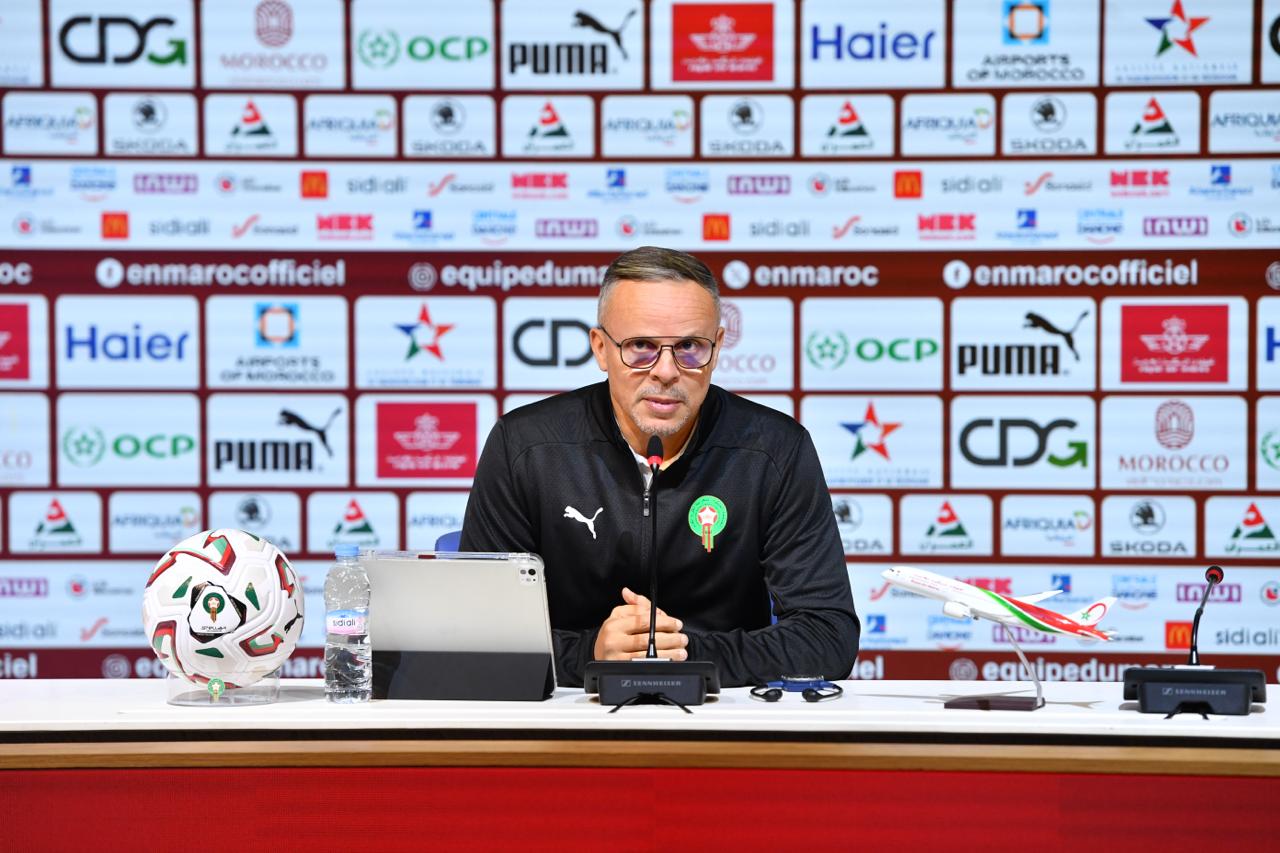
Mohamed Ouahbi has offered an insight into his plans for Morocco's national team after announcing a 26-player squad for the upcoming double-header against Niger in the 2027 Africa Cup of Nations qualifiers.
Speaking at a press conference on Wednesday, November 4, the Atlas Lions coach addressed several important selection decisions, including the return of Youssef En-Nesyri, the flexibility of Brahim Diaz, the inclusion of young attacking talents and his long-term vision ahead of the continental competition.
Morocco will face Niger on November 13 in Casablanca and November 17 in Rabat, with both matches representing an important opportunity to strengthen the team's foundations before AFCON 2027.
Ouahbi made it clear that winning remains the immediate priority, but he also wants to use this international window to move closer to the squad he intends to take to the tournament.
AFCON 2027: Building the Team Starts Now
For Ouahbi, the November gathering represents an important stage in Morocco's preparations.
With the next FIFA international window scheduled for March, the coach believes this is the right moment to assess additional options while giving continuity to players who could form the core of his future team.
- "Our priority is qualification: winning both matches," Ouahbi explained.
He added that the coaching staff wants to have a squad in March that is as close as possible to the one they intend to take to the Africa Cup of Nations.
The November fixtures therefore offer a valuable opportunity to test certain players, strengthen existing partnerships and improve the team's overall consistency.
The message is clear: Morocco must continue winning while preparing for the bigger challenges ahead.
Brahim Diaz Will Not Be Restricted to the Number 10 Role
One of the most interesting topics concerned Brahim Diaz and his positioning within the Moroccan attacking system.
Rather than automatically assigning him the traditional number 10 role, Ouahbi explained that his position will depend on the team's needs and the qualities of the players surrounding him.
- "If I see that Brahim can play as a number 10, he will play as a number 10," the coach explained.
He also mentioned Abdellah Ouazane, Bilal El Khannouss and Ismaël Saibari as players capable of operating in that position.
For Ouahbi, the objective is not to build the entire system around one player's preferred position. Instead, he wants to identify the most competitive combination and create effective relationships between the team's attacking talents.
That flexibility could become an important advantage for Morocco, particularly when facing opponents with different defensive approaches.
Why Morocco Selected Three Left-Backs
Ouahbi also addressed the decision to include three left-sided full-backs in his squad.
He explained that the selection was influenced by several factors, including player availability, current form and the need to provide additional coverage on the flanks.
During the previous gathering, Morocco had selected an extra right-back because Achraf Hakimi was returning from injury.
This time, the coaching staff opted for additional options on the opposite side.
Ouahbi specifically highlighted Souffian El Karouani, who has been accumulating playing time with Benfica, as one of the players whose current form influenced the decision.
The coach also noted that Morocco already had three right-backs in the squad, making it logical to strengthen the left side with two additional left-footed options.
The explanation reflects his desire to maintain balance across the defensive positions rather than simply selecting players based on their natural roles.
Youssef En-Nesyri’s Return: A Different Attacking Profile
Perhaps the most anticipated selection decision was the return of Youssef En-Nesyri.
The Al-Ittihad striker is back in the national-team picture after previously being left out, and Ouahbi explained that his inclusion is linked to the specific qualities he can offer against an opponent such as Niger.
The coaching staff has continued monitoring his performances at club level and believes his profile could provide Morocco with a different attacking dimension.
- "We know Youssef's qualities and what he can bring," Ouahbi explained.
He stressed that the previous selection decisions were not necessarily a reflection of En-Nesyri's ability, but rather an opportunity to assess other attacking profiles.
The coach also referred to the use of Ayoub El Kaabi during the World Cup, highlighting the differences between the two forwards.
En-Nesyri offers another type of attacking presence, and Ouahbi believes the current tactical approach could allow him to express his qualities more effectively.
The decision is therefore not simply about bringing back an experienced international. It is about adding a different solution to Morocco's attacking system.
Ayoub Oufkir: A Young Talent with Multiple Attacking Qualities
Another interesting inclusion is Ayoub Oufkir, who has earned an opportunity to demonstrate his abilities at senior international level.
Ouahbi described the youngster as a dynamic and technically gifted player capable of eliminating opponents in one-on-one situations.
The coach also highlighted his crossing ability, explaining that his deliveries could create important scoring opportunities for forwards such as En-Nesyri and Yassir Zabiri.
Oufkir's versatility is another important factor. According to Ouahbi, he can operate in different attacking positions and offers qualities that could become increasingly valuable as he develops.
The coach also mentioned Ouazane, particularly when deployed on the left, as another young player capable of contributing in several attacking roles.
Both youngsters are viewed as talents with significant long-term potential, but Ouahbi made it clear that their inclusion is also based on their current performances.
The objective is to introduce them into the national-team environment early, give them opportunities and help them develop alongside more experienced internationals.
Morocco's Long-Term Vision Goes Beyond Immediate Results
Ouahbi also explained that his selection policy is not based exclusively on short-term performances.
The coaching staff follows a large number of Moroccan players and evaluates their potential contribution to the national team over different periods.
- "Morocco must win today, but also in the medium and long term," he explained.
That philosophy is particularly relevant as the country prepares for AFCON 2027 and continues building a squad capable of competing at the highest level.
However, the coach acknowledged that selecting a smaller group of players means difficult decisions must be made. Not every player being monitored can receive an opportunity during the same international window.
For young talents, this gathering represents an important chance to demonstrate their readiness.
For established internationals, it is an opportunity to strengthen their position within the squad.
Improving After Every Match: Ouahbi's Message
Reflecting on Morocco's recent encounters against Mali, Lesotho and Gabon, the coach insisted that the team remains focused on continuous improvement.
Despite collecting important results in the qualifying campaign, Ouahbi wants the Atlas Lions to become more efficient and consistent in their performances.
He emphasised the importance of hard work, confidence and building momentum from one match to the next.
- "Our ambition is to be better after every match," he explained.
That statement captures the central objective of the November gathering. Morocco must secure qualification points against Niger while continuing to develop a more competitive collective identity.
Two Matches That Could Shape Morocco's Road to AFCON 2027
Ouahbi's latest comments reveal a coach trying to balance immediate expectations with the long-term construction of his national team.
Brahim Diaz's positional flexibility, En-Nesyri's return, Oufkir's introduction and the opportunities available to young talents all form part of a broader strategy.
The upcoming double-header against Niger will provide the first opportunity to see how those ideas translate onto the pitch.
For the Atlas Lions, the mission is twofold: keep winning on the road to AFCON 2027 and build a stronger, more versatile team capable of challenging for continental glory.