
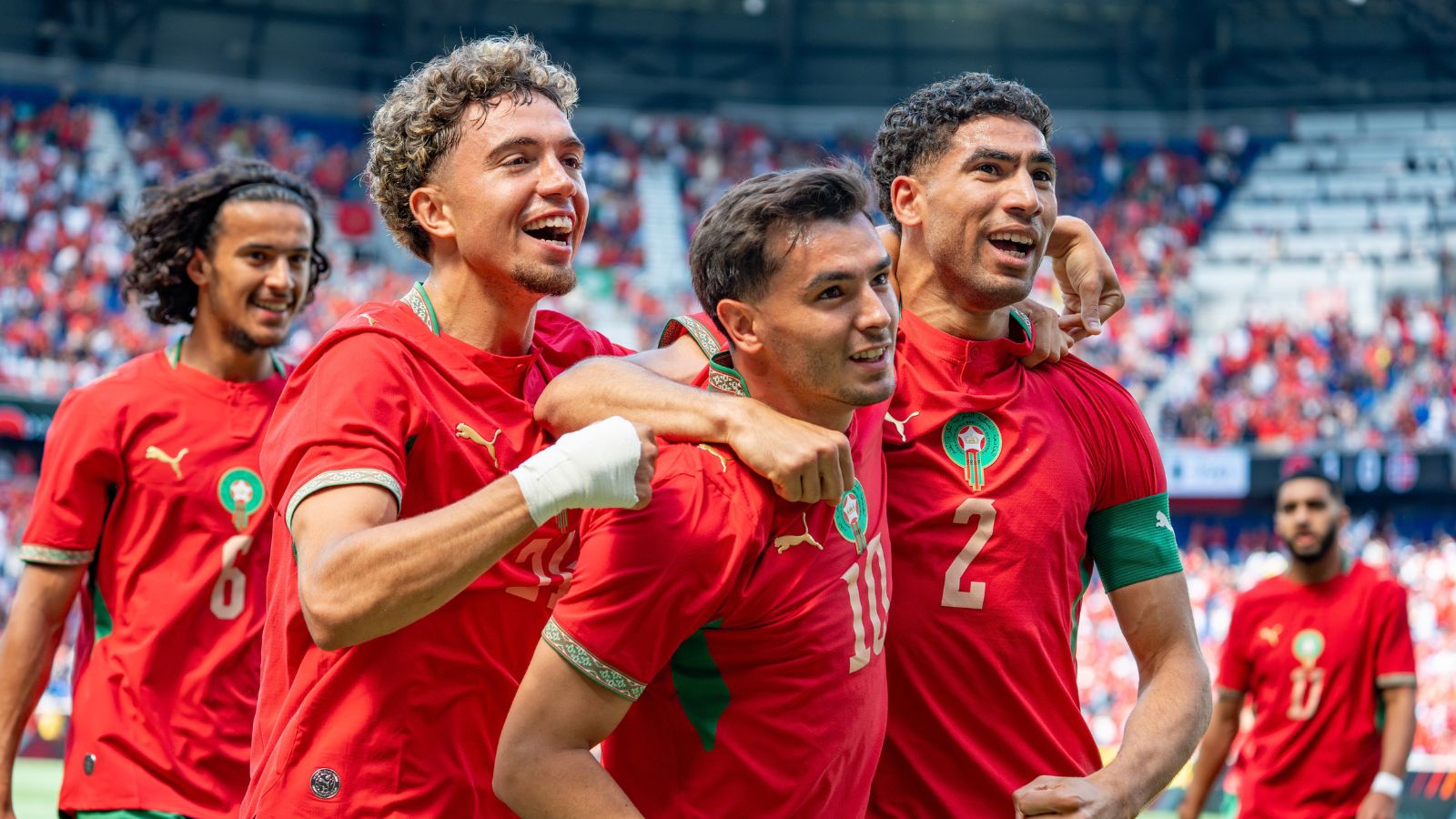
Morocco began their AFCON 2027 qualifying campaign with a 2–0 victory over Gabon, but the result also revealed one of the biggest differences between the Atlas Lions at full strength and the side that took the field in Rabat.
With Achraf Hakimi suspended and Brahim Diaz unavailable, Morocco were forced to operate without two players who have become central to the attacking identity of the right flank.
The team still found a way to secure the three points, but the right side lacked the usual explosiveness, creativity and ability to turn possession into clear danger.
A Right Side Missing Its Main Weapons
Mohamed Ouahbi opted for Ali Maamar at right-back, while Yassine Gessime was given a more advanced role.
Both youngsters represent part of Morocco’s next generation and have plenty of potential, but the match underlined the difference between potential and the level of influence currently provided by Hakimi and Diaz.
The right flank simply did not carry the same attacking weight.
There was less acceleration in possession, fewer threatening combinations and less movement capable of disturbing Gabon’s defensive structure.
The Hakimi Effect
Hakimi’s importance to Morocco extends far beyond his responsibilities as a defender.
The Paris Saint-Germain star regularly transforms the right side into an additional attacking lane, pushing forward at speed, stretching defensive lines and creating numerical superiority around the opposition box.
His ability to arrive from deep also forces defenders to make difficult decisions.
When he moves forward, an opponent has to decide whether to follow him or remain focused on the attacking players inside. That uncertainty is one of the reasons Morocco can create space even when facing a compact defense.
Without him, that particular dimension was missing against Gabon.
Diaz Brings a Different Threat
Brahim Diaz provides another type of danger.
Rather than simply staying wide, the Moroccan international can drift into central areas, receive between the lines, take on defenders and combine with the midfield and attack.
His movements can change the shape of an opposition defense.
That combination with the overlapping right-back has become an important part of Morocco’s attacking variety. One player can stretch the defense while the other moves inside, creating different passing angles and spaces around the final third.
Against Gabon, Morocco did not have that established partnership available.
Maamar and Gessime Face a Bigger Responsibility
For Ali Maamar, the challenge was particularly demanding.
The young defender was not only expected to perform his defensive duties but also to provide width, support the build-up and help create attacking depth on the right.
Gessime, meanwhile, needed to find space higher up the pitch and provide the movement required to unlock a Gabonese side that often defended compactly.
Neither player can be judged solely on one match, especially when playing in a combination that has not had the same time to develop as Morocco’s more established options.
But the difference in attacking influence was visible.
More Than Just Two Missing Players
The problem was not simply the absence of two individuals.
Morocco's attacking game depends on the movements around them. The midfield must deliver the ball quickly, the forwards must create space and the full-backs must recognize when to advance.
Yet Hakimi and Diaz possess the individual quality to change the rhythm of an attack almost instantly.
They can accelerate a move, eliminate a defender, create an overload or turn a seemingly harmless possession into a dangerous situation.
That is precisely what Morocco lacked at times against Gabon.
A Useful Lesson for Ouahbi
For Ouahbi, however, the match offered valuable information.
Morocco will not always have every key player available, whether because of suspension, injury or rotation. Developing alternatives on both sides of the pitch will therefore be essential as the team moves through the AFCON qualifying campaign and prepares for bigger challenges ahead.
The 2–0 victory remains the priority, and Morocco successfully secured the three points.
But the match also highlighted an important reality: when Hakimi and Diaz are absent, Morocco’s right flank loses a significant part of its attacking identity.
Finding ways to maintain that threat, even without two of the team's most influential players, will be one of the interesting challenges for Ouahbi as the new cycle continues.