
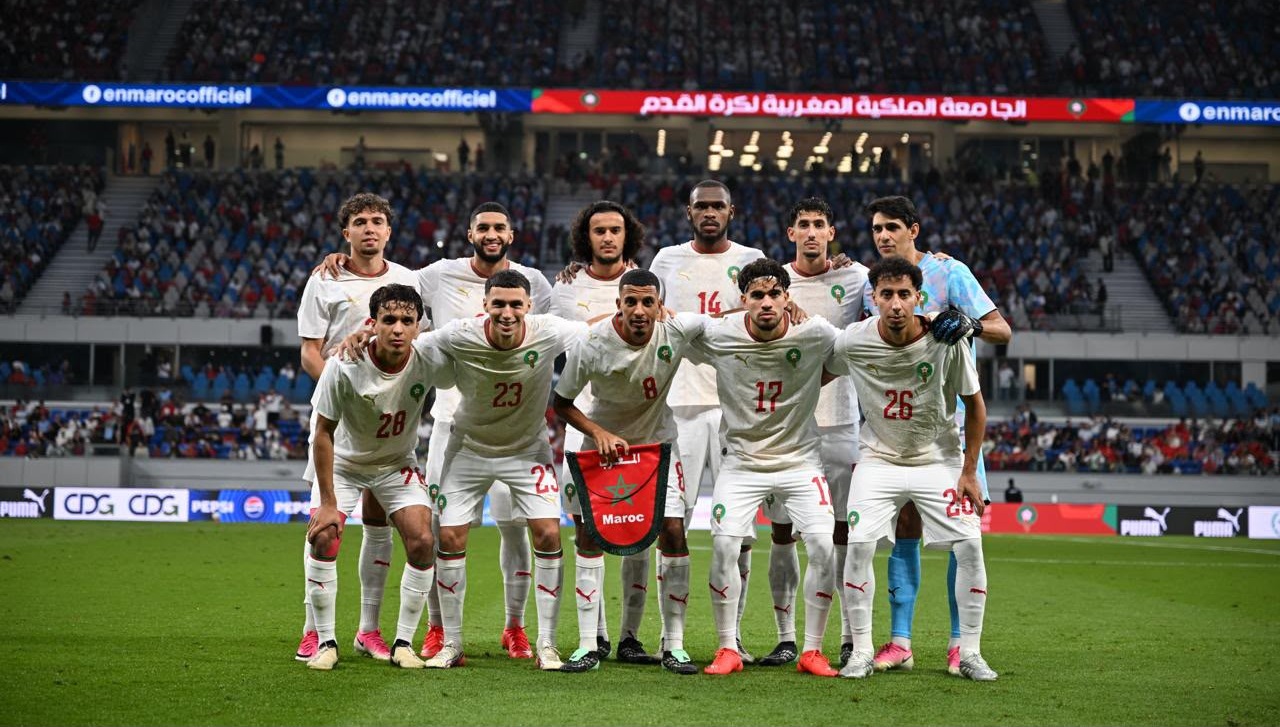
Morocco have collected the six points available from their opening two matches in the 2027 Africa Cup of Nations qualifiers, but results alone have not silenced every question surrounding the Atlas Lions. As Mohamed Ouahbi prepares for November’s double-header against Niger, the upcoming international window offers another opportunity to strengthen his squad and build momentum ahead of the continental tournament.
The Atlas Lions defeated Gabon and Lesotho 2-0 in September, establishing themselves at the top of their qualifying group. However, their subsequent 1-1 draw against Mali on October 4 exposed areas that still require attention, particularly when facing stronger opposition.
With Morocco scheduled to meet Niger on November 13 and 17, the national team could benefit from the return of familiar faces, the inclusion of in-form players and a more balanced approach to distributing playing time.
The question is no longer simply which players deserve a call-up. It is how Ouahbi can use this gathering to build a team capable of competing for the Africa Cup of Nations title.
Defence: Could Omar Al Hilali Earn His Opportunity?
One name worth watching is Omar Al Hilali, the Espanyol Barcelona right-back who has established himself as a regular option at club level.
During the previous international gathering, Ouahbi called up young defender Ali Maamar, who had been enjoying a promising start to the season with Anderlecht. The Under-20 World Cup winner made his official debut for Morocco, gaining valuable experience without yet establishing himself as an automatic choice.
Al Hilali could offer a different profile. His pace, defensive intensity and ability to handle one-on-one situations make him an interesting option for a Moroccan defence that needs both reliability and flexibility.
Although primarily a right-back, he could also provide tactical versatility in a system featuring three central defenders. A back three involving Abdelhamid Aït Boudlal and Issa Diop, alongside another centre-back, could allow the wing-backs to push higher up the pitch.
That arrangement could suit Achraf Hakimi, whose speed, crossing ability and attacking movement make him particularly dangerous when given the freedom to advance along the right flank.
Morocco already possess several established defensive options, including Nayef Aguerd, Anass Salah-Eddine and the aforementioned defenders. The challenge for Ouahbi will be to identify the combinations that offer the best balance between defensive security and attacking ambition.
Just as importantly, squad selection must be accompanied by meaningful opportunities. Players such as Marouane Saadane and Redouane Halhal were called up previously without playing a single minute. Giving fringe players a chance against Niger could help the coaching staff assess their readiness before the pressure of the Africa Cup of Nations increases.
Midfield: Reda Belahyane Could Offer a New Dimension
The midfield is another area where Morocco could benefit from a fresh option, with Reda Belahyane potentially making a strong case for his return.
The midfielder previously received a national-team call-up under Walid Regragui in 2024 after impressing with Hellas Verona. His subsequent difficulties securing regular playing time at Lazio, however, complicated his international prospects.
According to the supplied report, his situation has improved under Gennaro Gattuso, with the Moroccan midfielder enjoying a more prominent role during Lazio's strong start to the season.
Belahyane's potential value to Morocco extends beyond his ability to recover possession. He is comfortable receiving the ball under pressure, distributing it from deeper positions and finding forward passing lanes that can break opposition lines.
His profile resembles that of a deep-lying playmaker, often described as a regista in Italian football. Rather than operating exclusively as a defensive midfielder or an attacking creator, he can help connect both phases of play.
That combination could prove valuable against opponents who defend compactly and force Morocco to build patiently through the middle.
His defensive commitment and willingness to compete physically would also add another dimension to the midfield. If his club form continues, a recall could give Ouahbi a useful opportunity to evaluate whether he can bring greater balance and control to the Atlas Lions.
Attack: Is It Time for Youssef En-Nesyri to Return?
Morocco's attacking options could also be reshaped by the absence of the injured Soufiane Rahimi.
One possible solution is Youssef En-Nesyri, whose experience and traditional centre-forward profile could offer the national team a different way to approach attacking situations.
The striker's ability to occupy central defenders, attack crosses and provide a presence inside
the penalty area gives Morocco an alternative when their usual combinations fail to create clear openings.
The supplied report credits En-Nesyri with eight goals and two assists in 14 appearances this season for Al-Ittihad. If those numbers are confirmed, they would strengthen the argument for considering him again as the team prepares for its next international commitments.
His potential return would not necessarily mean a guaranteed starting position. Instead, it would give Ouahbi another experienced option and allow him to adapt his attacking approach depending on the opponent.
Another player attracting attention is Yassir Zabiri, who has reportedly been producing decisive performances with Racing de Santander. The young forward could represent a longer-term investment, offering the coaching staff a chance to assess his potential alongside more established international players.
With the Africa Cup of Nations approaching, balancing experience with emerging talent could be crucial to building a versatile attack.
Goalkeepers: Why Rotation Matters for Morocco
The goalkeeping position presents one of the clearest opportunities for Ouahbi to experiment.
Yassine Bounou remains Morocco's established first-choice goalkeeper and has repeatedly demonstrated his value in important matches. His performance against Mali, in particular, helped the Atlas Lions avoid defeat.
However, the previous international gathering raised questions about the distribution of playing time. Munir El Kajoui, Ahmed Reda Tagnaouti and Alaa Bellaarouch reportedly remained unused across the three matches, leaving the coaching staff with limited new information about their readiness in competitive international football.
Against Gabon and Lesotho, where Morocco generally faced less attacking pressure, there may have been opportunities to give another goalkeeper a chance.
Alaa Bellaarouch is one possible candidate. The supplied report highlights his performances for Dinamo Bucharest, citing an 80.9% save rate and five clean sheets. Those figures would make him an interesting option to assess, although club statistics alone cannot determine his suitability for the national team.
Rotating goalkeepers does not mean diminishing Bounou's importance. It means ensuring that Morocco have reliable alternatives should injuries, suspensions or changing circumstances require them.
A tournament-winning squad needs more than a strong starting eleven. It needs players who are prepared to contribute when called upon.
Niger Double-Header: More Than Just Six Points
The November fixtures offer Morocco an opportunity to maintain their position in the qualifying group while addressing several tactical and squad-management questions.
Ouahbi must decide whether to reward players who are performing consistently at club level, recall experienced internationals who could strengthen the team and give emerging talents the minutes they need to develop.
The challenge is to strike the right balance. Too many changes could disrupt the team's cohesion, while too few could leave important questions unanswered before the tournament.
The coaching staff will also want to see greater authority in possession, improved attacking combinations and a more convincing overall performance against Niger.
With the 2027 Africa Cup of Nations scheduled to take place in Kenya, Tanzania and Uganda, the countdown to the continental competition is becoming increasingly important.
Mohamed Ouahbi's Decisions Could Shape Morocco's Next Step
Omar Al Hilali could strengthen the defensive options. Reda Belahyane could add control and composure in midfield. Youssef En-Nesyri could provide an experienced attacking alternative, while opportunities for reserve goalkeepers could help Morocco prepare for the unexpected.
None of these selections is guaranteed, and club form must ultimately be assessed alongside tactical fit, fitness and the needs of the national team.
But the underlying objective is clear: Morocco need to turn promising results into increasingly convincing performances.
The November matches are not just another step towards AFCON 2027. They are an opportunity for Mohamed Ouahbi to discover which players can help the Atlas Lions turn their ambitions into reality.