
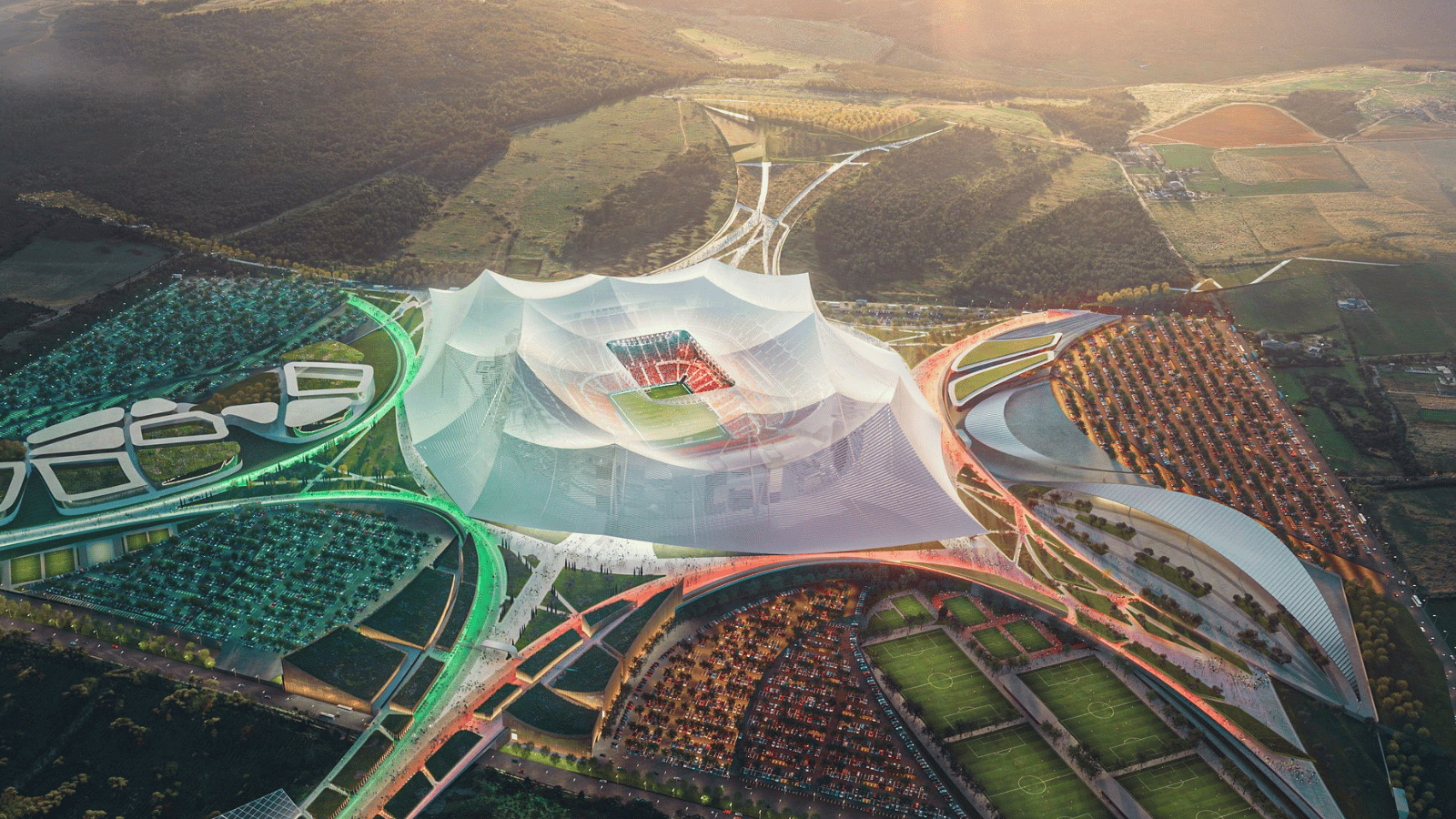
Morocco’s ambition to host the 2030 FIFA World Cup final extends far beyond the construction of a spectacular stadium. As the Kingdom positions itself among the tournament’s leading venues, attention is increasingly turning to the infrastructure needed to welcome thousands of supporters and deliver a seamless experience on football’s biggest stage.
Spanish newspaper Sport has taken a closer look at the Grand Stade Hassan II, the ambitious project planned for Benslimane, near Casablanca, which is competing with Madrid’s Santiago Bernabéu and Barcelona’s Camp Nou to host the tournament’s final.
While the proposed stadium’s extraordinary capacity of 115,000 spectators has attracted significant attention, the Catalan publication has also examined the practical challenges surrounding the project, particularly transport links and access to the future venue.
A Stadium Designed to Make History
The Grand Stade Hassan II stands at the centre of Morocco’s ambitions for the 2030 World Cup, which the country will co-host with Spain and Portugal.
With a planned capacity of 115,000 seats, the stadium is intended to become one of the defining venues of the tournament. Its scale reflects Morocco’s determination to deliver an arena capable of hosting one of the most prestigious events in world football.
However, as Sport points out, the project must be viewed within a broader development strategy.
The stadium’s success will depend not only on its architecture and facilities but also on the infrastructure surrounding it.
The objective is to create a venue that can accommodate enormous crowds while ensuring efficient access for supporters travelling from Casablanca, Rabat and other parts of the country.
Transport and Accessibility Among the Main Challenges
One of the central issues highlighted by the Spanish newspaper is accessibility.
A stadium designed to accommodate more than 100,000 spectators will require carefully coordinated transport arrangements, particularly on matchdays when large numbers of fans arrive and leave within a limited period.
The integration of rail services, improvements to local transport connections and better management of passenger flows will therefore be essential components of the wider project.
These measures could help reduce pressure on surrounding roads while making journeys to and from the stadium more convenient for domestic and international visitors.
The challenge is not simply to build a world-class football venue. Morocco must also ensure that supporters can reach it efficiently, regardless of where they are staying or travelling from.
Strengthening the Casablanca–Rabat Connection
Road infrastructure is another important element of the preparations.
The motorway connecting Casablanca and Rabat is expected to play a significant role in improving connectivity between the two urban centres. Their proximity to major World Cup venues makes this corridor particularly important for supporters, officials and other tournament visitors.
Rabat is set to rely on the Prince Moulay Abdellah Sports Complex, while the Grand Stade Hassan II is planned for Benslimane, close to Casablanca.
Strengthening transport links between these areas would help support movement across the wider host region, although the scale of the challenge will require coordinated planning across different transport networks.
The objective is to ensure that the tournament operates as a connected national event rather than a collection of isolated stadiums.
A Project That Goes Beyond Football
In its coverage, Sport presents the Grand Stade Hassan II as part of a wider Moroccan development strategy that reaches beyond the World Cup itself.
The project brings together several ambitions: strengthening sports infrastructure, attracting tourism, encouraging investment and improving transport connections.
For Morocco, the long-term value of the tournament will depend partly on how effectively these investments serve the country after the final whistle. Better connectivity and upgraded infrastructure could continue to benefit residents, businesses and visitors well beyond 2030.
The stadium therefore represents both an opportunity and a considerable logistical undertaking. Its scale could make it a landmark venue, but delivering the surrounding infrastructure will be equally important to fulfilling its potential.
Six Host Cities for Morocco’s 2030 World Cup
Morocco plans to stage matches across six host cities and six stadiums: Casablanca, Rabat, Tangier, Fez, Marrakech and Agadir.
This national footprint makes transport coordination a central part of the country’s preparations. Supporters will need reliable connections between cities, accommodation, transport hubs and stadiums throughout the competition.
The Grand Stade Hassan II may become one of the tournament’s most recognisable venues, but its success will depend on more than the number of seats or the scale of its architecture.
As preparations continue, the challenge for Morocco will be to match its sporting ambition with an efficient transport network and a connected host-city experience.
The stadium could become a defining symbol of the 2030 World Cup, while the infrastructure built around it may prove just as important to the Kingdom’s long-term legacy.