
The Penalty, the Silence, and the Badge
When Achraf Hakimi stepped up to take Morocco's deciding penalty against Spain at the 2022 World Cup, he panenka'd it down the middle and didn't celebrate.
He pointed at the badge instead.
Three and a half years later, he walks out at MetLife Stadium on [June 13, 2026](/news/morocco-vs-brazil-world-cup-2026-opener) as Morocco's captain — the most decorated player in the squad, and by a meaningful margin, the most complete attacking full-back in international football.
A Stat Line the Sport Has Rarely Seen
Hakimi's stat line at PSG is the easiest version of the argument. He has averaged double-digit goal contributions in domestic football every season since 2019 — across Borussia Dortmund, Inter, and PSG.
That is territory only a handful of players have ever occupied: Cafu, Roberto Carlos, Dani Alves, Trent Alexander-Arnold — and, on any honest read, Hakimi.
What separates him from the modern list is the two-way demand. PSG and Inter are top-tier defensive systems; he is not asked to be a winger who occasionally tracks back. He is asked to defend at international standard and produce in transition at international standard — and he delivers both.
The 2022 World Cup semifinal run was built, in defensive terms, on his ability to neutralise the right side of Belgium, Spain, and Portugal's attack — while still serving as Morocco's most dangerous outlet on the counter. Dima Maghrib.
The Right Flank of Ouahbi's Vision
[Mohamed Ouahbi's](/news/mohamed-ouahbi-morocco-head-coach) Morocco operates in a 4-1-4-1 or a 4-3-3, both of which lean on full-back-driven progression.
Hakimi is not a wing-back. He is a right back asked to do wing-back work without sacrificing the structural cover behind him — a distinction that demands a rare combination of intelligence and athleticism that very few players on earth possess.
RotoWire's 2026 tactical preview confirms he is one of three designated set-piece takers alongside Abde and Diaz. Morocco's set-piece infrastructure is essentially built around his delivery.
More Than a Captain — A Compass
The biggest evolution since 2022 is leadership. Hakimi was a senior player in Qatar. He is the captain now.
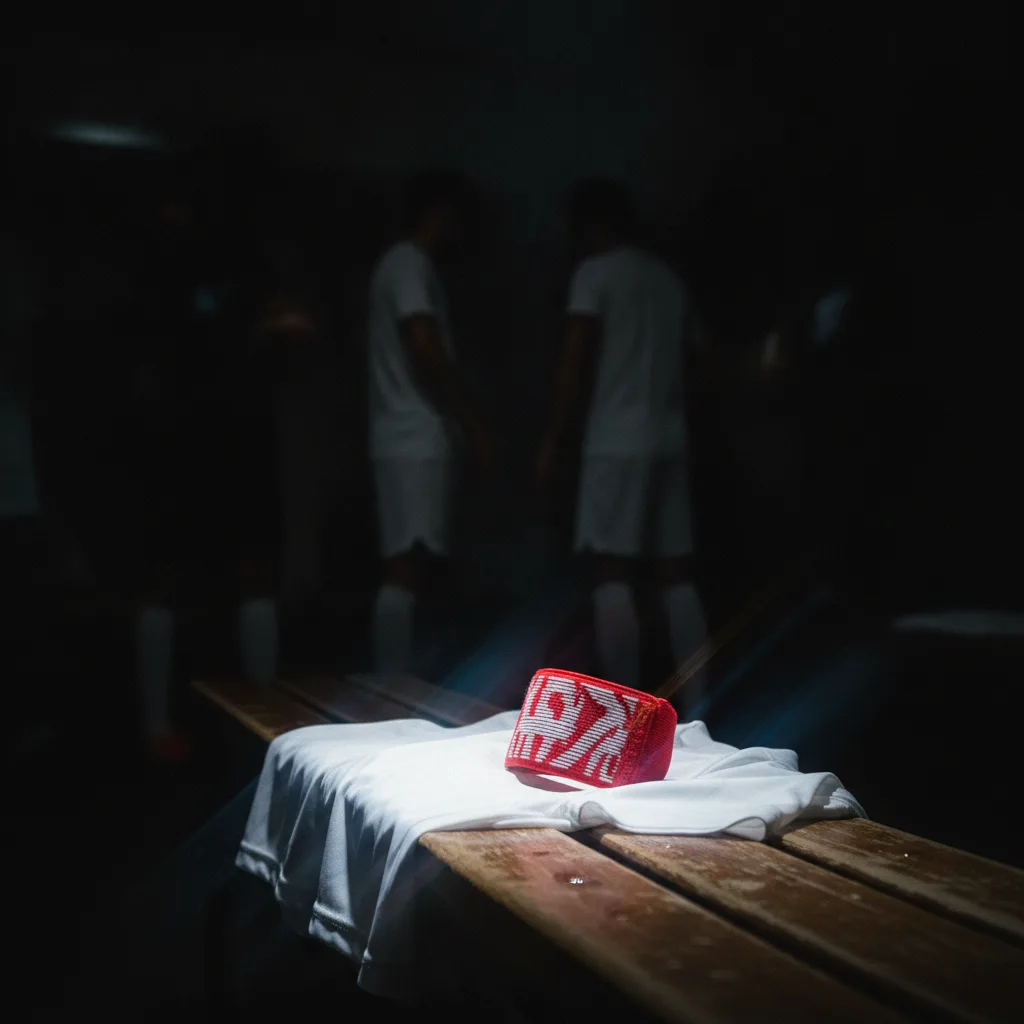
The armband matters less for tactical reasons and more for what it means in the pressure-cooker moments of tournament football — those ten-minute spells where Morocco absorb wave after wave, where someone needs to slow the game at a throw-in, where a young substitute steps into the wall of noise at MetLife Stadium and needs an arm around the shoulder.
That someone is Achraf Hakimi.
The Marquee Battle — Hakimi and Vinicius at MetLife
Hakimi against Brazil is the marquee individual battle of the opener. Brazil's structure isolates wide attackers in one-v-one situations, forcing the opposing full-back into either a foul or a backpedal.
Vinicius Junior — assuming he starts — will be on Hakimi's side of the pitch for long stretches.
The version of Hakimi that pins Vinicius back through threat — not just defending him, but threatening to attack the space *behind* him — is the version that gives Morocco the draw or the win. That is exactly the Qatar Hakimi. Yalla Maghreb!
A Career That Maps a Golden Era
Hakimi turned 27 in late 2025. By 2030, when Morocco co-host the World Cup with Spain and Portugal, he will be 31 — likely still elite, and unquestionably the senior face of the federation.
His international arc mirrors Morocco's golden era almost exactly: he debuted at 17, became a starter for the 2022 semifinal team, took the armband for [the AFCON 2025 trophy](/news/morocco-afcon-2025-winners-senegal-stripped), and now leads the side into a World Cup played in the country where his club career began — he was at Real Madrid before Dortmund.
This is not Hakimi's first World Cup. It is the first one he walks into as Morocco's captain — and the first one where his country steps onto the pitch carrying the full weight of a golden generation behind them.
Everything since that silent celebration in Qatar — the badge point, the semifinal nights, the armband — has been building toward a single moment: June 13, at MetLife, against Brazil, under the red and green. The preparation is over. This is what it was all for.
*See also:* [Mohamed Ouahbi: meet Morocco's new head coach](/news/mohamed-ouahbi-morocco-head-coach) · [Morocco vs Brazil — the opener that decides Group C](/news/morocco-vs-brazil-world-cup-2026-opener) · [Morocco's 2022 World Cup run](/news/morocco-2022-world-cup-run)